

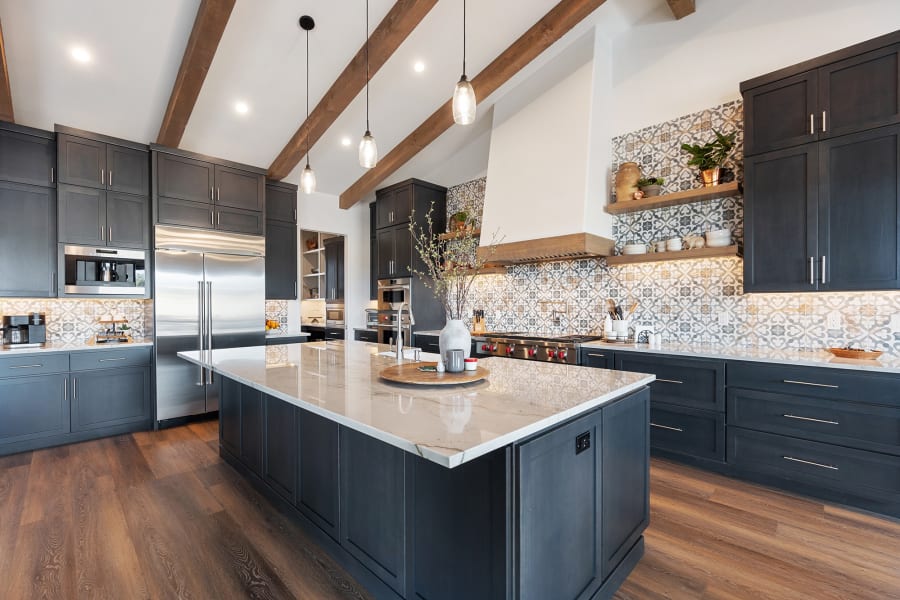
Choosing new kitchen countertops often comes down to two favorites: quartz and granite. Both are durable, attractive, and available in colors and patterns that complement almost any kitchen. But they have important differences. Quartz offers a consistent look and easy maintenance, while granite delivers the natural beauty and unique character of real stone. So, which is better for your kitchen? Let’s compare quartz and granite countertops based on appearance, durability, maintenance, heat resistance, stain resistance, cost, and everyday use.
What is the difference between quartz and granite countertops?
Granite is a natural stone quarried from the earth, cut into slabs, polished, and fabricated for your kitchen. Every slab is different, with its own colors, mineral deposits, veining, and movement.
Quartz countertops are engineered surfaces made primarily from quartz minerals combined with resins and pigments. This process creates more consistent colors and patterns.
At Kitchen & Bath Creations, you can compare quartz and granite countertops alongside cabinetry and other kitchen design elements.
Which looks better, quartz or granite?
This comes down to personal style.
Granite is ideal if you love natural variation. Some slabs have subtle patterns, while others feature dramatic veining, speckles, and color changes. No two slabs are exactly alike.
Quartz provides a more controlled appearance. Options range from clean whites and warm neutrals to dark colors and marble-inspired patterns. Its consistency can make coordinating countertops with cabinets, backsplashes, flooring, and hardware easier.
Both materials work with traditional, transitional, contemporary, modern, farmhouse, and other kitchen styles.
Is quartz or granite more durable?
Both are highly durable countertop materials.
Granite is a hard natural stone that stands up well to everyday kitchen activity. Quartz is also highly durable and offers excellent resistance to common scratches, chips, and stains.
However, neither material is indestructible. Heavy impacts can damage edges and corners. You should also avoid cutting directly on either surface. Using cutting boards protects both your countertops and your knives.
With proper care, quartz and granite countertops can provide years of dependable performance.
Is quartz or granite more stain-resistant?
Quartz generally has the advantage.
Because quartz is nonporous, liquids do not readily penetrate its surface. Coffee, juice, cooking oils, and other common kitchen spills are less likely to cause stains when cleaned promptly.
Granite is porous and typically needs sealing to improve stain resistance. Properly sealed granite can resist everyday spills very well, but it requires more attention over time.
For homeowners who prioritize easy maintenance and stain resistance, quartz may be the better choice.
Is quartz or granite more heat-resistant?
Granite generally provides better natural heat resistance.
Quartz handles normal kitchen temperatures well, but its resins can be affected by excessive heat. Placing very hot cookware directly on quartz could cause discoloration or damage.
Although granite handles heat better, it is still smart to protect the surface. Use trivets or hot pads under hot pots and pans with either countertop material.
Does quartz or granite require more maintenance?
Quartz is generally easier to maintain.
For routine cleaning, quartz typically requires only mild soap, water, and a soft cloth. Because the surface is nonporous, it does not need routine sealing.
Granite is also easy to clean but may require periodic sealing to help prevent stains and moisture absorption. Sealing frequency depends on the specific stone and sealer.
Avoid harsh or abrasive cleaning products unless they are approved for your countertop material.
Is quartz more expensive than granite?
Quartz and granite countertop prices often overlap.
The final cost depends on the specific material, color, pattern, slab, thickness, edge profile, fabrication requirements, and complexity of your kitchen layout.
Some granite options are relatively affordable, while rare or distinctive slabs can cost considerably more. Quartz also ranges from budget-friendly selections to premium designs.
Rather than comparing price alone, consider the total project cost along with appearance, durability, and maintenance.
Is quartz or granite better for a busy kitchen?
Quartz is often an excellent choice for busy kitchens because it combines durability, stain resistance, and low maintenance. There is no routine sealing to remember, making everyday care simple.
Granite may be better if you prioritize natural stone, unique patterns, and excellent heat resistance.
Think about how you use your kitchen. If you cook daily, have children, entertain frequently, or simply want less maintenance, those factors can help determine which surface fits your lifestyle.
How do you choose between quartz and granite countertops?
Choose quartz if you want consistent colors and patterns, low maintenance, strong stain resistance, and plenty of design flexibility.
Choose granite if you prefer genuine natural stone, one-of-a-kind patterns, natural variation, and excellent heat resistance.
Compare countertop samples with your cabinets, backsplash, flooring, hardware, and lighting before making a final decision. Seeing the materials together can make choosing much easier.
The source for quartz and granite countertops in Columbia, MD, Nottingham, MD, Rosedale, MD, Annapolis, MD, and Selbyville, DE.
Since 2003, Kitchen & Bath Creations has served homeowners, builders, contractors, architects, apartment management companies, and design professionals throughout the Mid-Atlantic region. Our experienced in-house design consultants can help you compare countertop materials while considering your cabinetry, kitchen layout, style, needs, and budget.
Schedule a design consultation today to explore quartz and granite countertops and find the right surface for your kitchen. We have showrooms in Columbia, MD, Nottingham, MD, Rosedale, MD, Annapolis, MD, and Selbyville, DE.